
The Wandercraft Exoskeleton, Explained: How a Machine Lets a Paralyzed Veteran Walk Again
A plain-English guide to Wandercraft's self-balancing exoskeleton: how it works, what the FDA cleared and when, who qualifies, and how veterans pay.


For most of the last fifty years, "walking again" after a spinal cord injury has meant one of two things. Either a person had enough remaining function to work toward it in physical therapy, or the wheelchair became permanent.
The Wandercraft exoskeleton is one of the first devices to offer a real third option. It is a wearable robot that stands a paralyzed person up, holds their balance for them, and walks with their hands free.
Walk For A Hero Foundation exists to put that machine in the homes of paralyzed U.S. veterans, one named hero at a time. This explainer covers what the device is, how it differs from earlier exoskeletons, what the FDA has and has not cleared it to do, who can use it, what training looks like, and how veterans can pay for it.

What a self-balancing exoskeleton actually does
A powered exoskeleton is a motorized frame worn over the legs and torso. Motors at the joints move the legs through a walking pattern that the user's own nerves can no longer command.
The hard part has never been moving the legs. It has been balance. A person with a complete spinal cord injury cannot feel or correct a stumble, so the first generation of personal exoskeletons handed that job back to the user's arms.
The ReWalk Personal System, which MD+DI described as the first wearable, motorized device the FDA cleared to help people with paraplegia walk, is the clearest example. When the agency cleared it in June 2014, it described a fitted brace with motors at the hips, knees and ankles, a backpack computer, and a wrist-worn remote, with crutches providing stability, according to MD+DI's report on the clearance. In the FDA's words, "Crutches provide the user with additional stability when walking, standing, and rising up from a chair." It was cleared for people with injuries from T7 to L5, used with a trained caregiver.
Wandercraft's design removes the crutches. Its software keeps the wearer upright on its own, so both hands stay free, with no crutches tying them up. Industry publication The Exoskeleton Report put it plainly in its coverage of the Eve clearance: "Unlike most medical exoskeletons, it did not require crutches or a walker to maintain balance." Eve carries that same approach into the home.
Wandercraft says Atalante X is "the only FDA cleared exoskeleton with a powered ankle mechanism that can perform complex ankle movements that mimic a natural human gait," according to the company's February 2024 announcement.
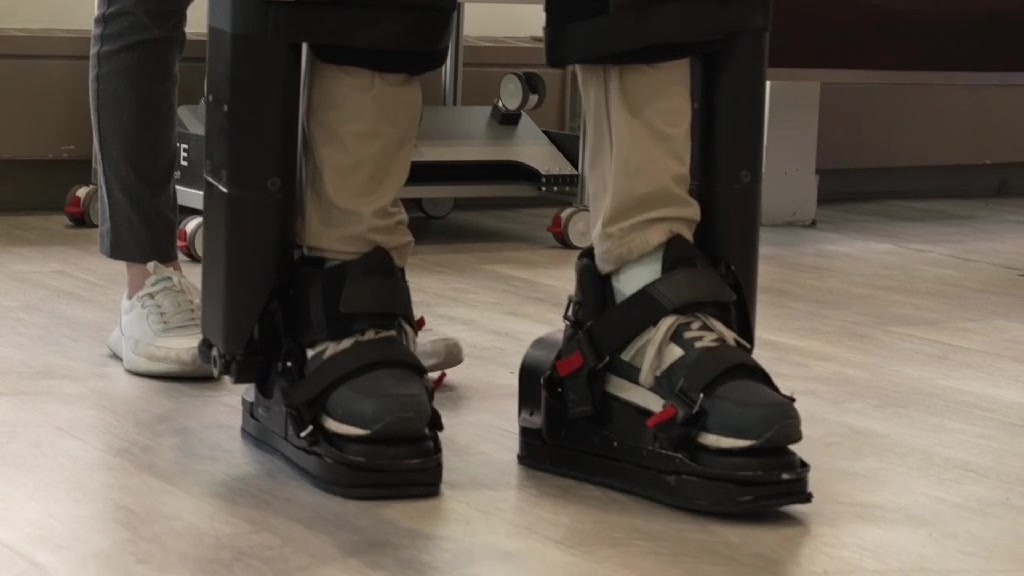
Two machines: Atalante X for the clinic, Eve for the home
Wandercraft, a Paris-based company, makes two self-balancing walking exoskeletons for the U.S. market. They share the same self-balancing approach but are cleared for very different settings.
Atalante X is the rehabilitation device. It lives in hospitals and therapy centers and is operated by trained therapists. Wandercraft says it is used in more than 150 rehabilitation and research centers worldwide.
Eve is the personal device. It is prescribed to one person, fitted to that person's body, and used at home with a trained companion. Wandercraft describes it as designed "to complement, not replace, the wheelchair."
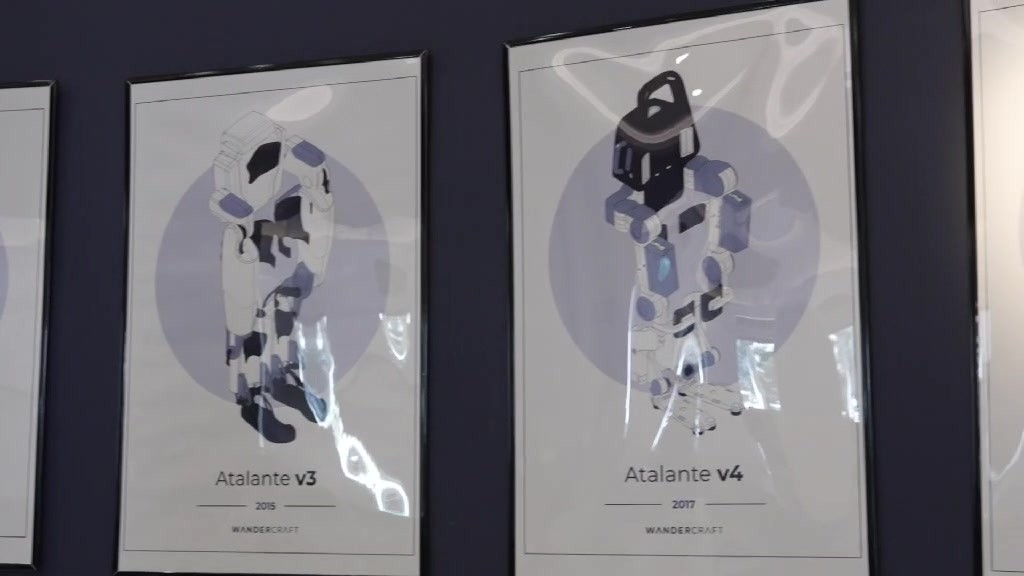
The company has been building toward this for a decade. Framed posters at Walk In New York trace the device's early generations, from Atalante v3 in 2015 to Atalante v4 in 2017.
The FDA record, clearance by clearance
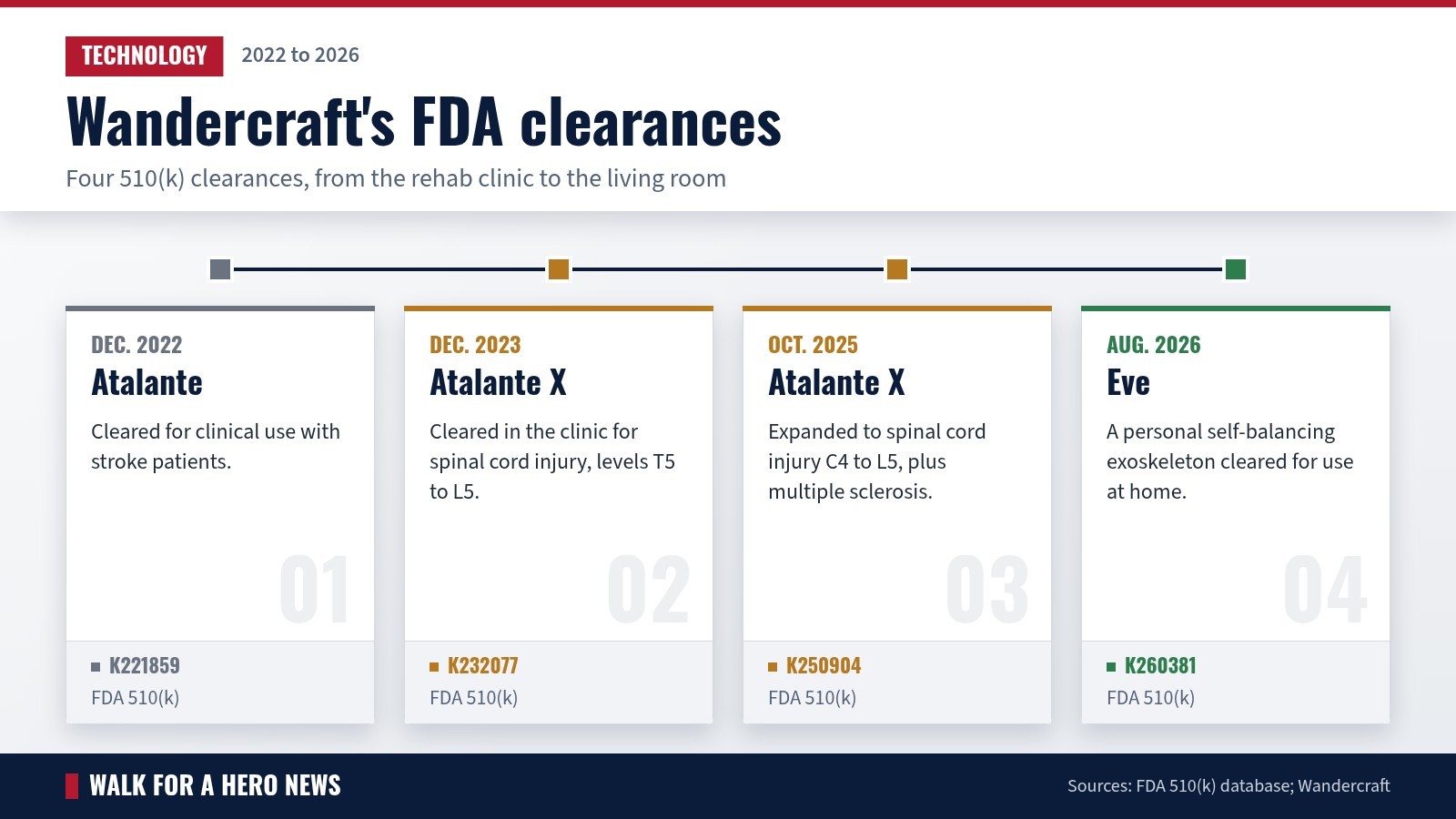
Each of these Wandercraft devices has gone through the FDA's 510(k) premarket notification process, which requires a manufacturer to show a device is substantially equivalent to one already legally marketed. That makes Wandercraft's exoskeletons FDA-cleared, the correct term for devices that come through 510(k). Premarket approval is a separate pathway used for the highest-risk devices.
All four clearances fall under the FDA's "Powered Exoskeleton" classification, product code PHL. The record in the FDA's 510(k) database shows:
- December 29, 2022 (K221859): Atalante, cleared for rehabilitation of people with hemiplegia after a stroke.
- December 13, 2023 (K232077): Atalante X, adding spinal cord injuries at levels T5 to L5. Wandercraft announced this clearance publicly on February 13, 2024, citing data from more than 500 patients.
- October 24, 2025 (K250904): Atalante X, expanding the spinal cord injury range to C4 to L5 and adding multiple sclerosis.
- August 3, 2026 (K260381): Eve, the personal exoskeleton, for people with spinal cord injury at any level. Wandercraft announced it on August 11, 2026.
The scope of the Eve clearance matters. Its indications for use state that Eve "is intended to enable the user to perform walking functions and activities of daily living, hands-free, utilizing self-balancing technology, in home and community settings."
The same document sets the limits. Use is restricted to indoor areas and open-air spaces that are part of a building's structure, such as a patio or courtyard, under the supervision of a specially trained companion. The FDA summary states Eve "is not intended for sports or stair climbing."
Atalante X, by contrast, remains a clinic device. Its current indications limit it to "rehabilitation institutions under the supervision of a trained operator."
Together, Atalante X and Eve may offer eligible users a pathway from walking during rehabilitation to upright mobility at home, whether making coffee at the kitchen counter, reaching for a book, or spending time with friends on the patio.
Matthieu Masselin, co-founder and CEO of Wandercraft, August 11, 2026
Who medically qualifies
Eligibility starts with the FDA label. Eve is intended for adults 18 and older with a spinal cord injury at any level who can operate the device with a handheld controller and can tolerate a standing position, according to the clearance documents.
That "any level" language is notable. It means the device is not limited to a narrower band of injuries, like the T7 to L5 range the ReWalk was first cleared for. A person with a high injury can qualify, as long as they can work the controller.
The label is only the first gate. Eve must be prescribed by a licensed healthcare practitioner, and every user goes through a clinical assessment and an individualized fitting before training, Wandercraft says. In the VA's own exoskeleton protocol, for example, that evaluation includes bone density testing, range of motion and body measurements.
The device itself is substantial. The FDA summary lists Eve's weight at 183 pounds in its largest setting, with components sized from small to extra-large and adjusted to each user's body.
Across the field, the pool of candidates is large. Over 20,000 people have medically qualified for exoskeleton technology in the last decade. Walk For A Hero's goal is to fund approximately 100.
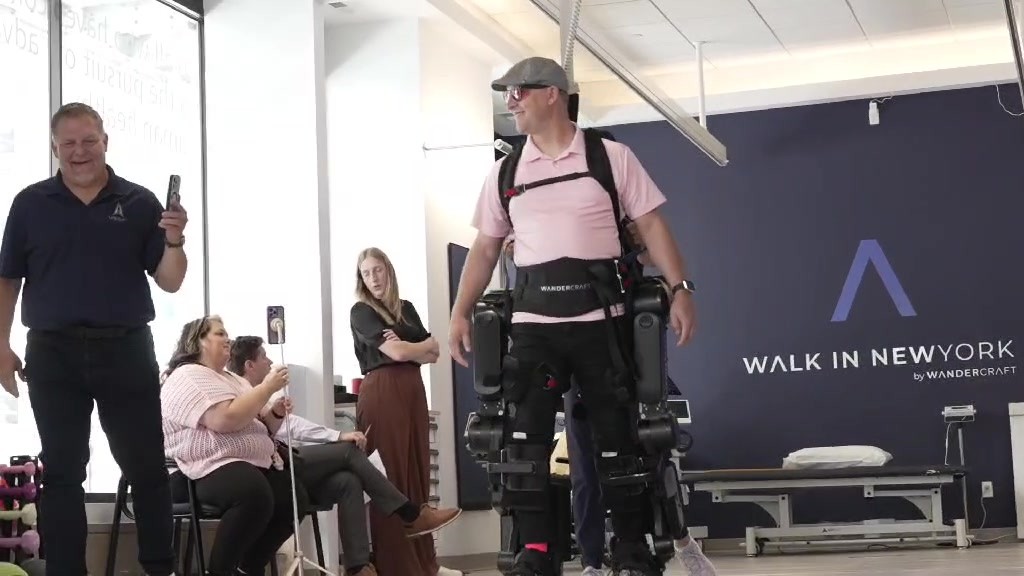
What training looks like
No one takes an Eve home after a demonstration. Wandercraft's launch announcement lays out a structured program that the user and companion complete together.
Training consists of five two-hour sessions that can be completed in as little as one week. It covers transfers in and out of the device, operating the remote controller, walking on level surfaces, moving through tight spaces, activities of daily living, and safety and emergency procedures.
The companion is central. The FDA clearance requires a specially trained companion to supervise every use, so a spouse, family member or caregiver trains alongside the veteran and is certified through the same program.
A VA hospital helped build the evidence behind Eve. Wandercraft says its FDA clearance was supported by trials led by the James J. Peters Department of Veterans Affairs Medical Center in the Bronx and Kessler Foundation in West Orange, New Jersey, plus a separate study at Walk In New York.
For years, I experienced much of the world while seated. Using Eve transformed ordinary moments in ways I never expected, like having conversations eye-to-eye whether seated or standing, getting a cup from the highest kitchen cabinet, and simply bringing a new type of confidence into my life.
Caroline Laubach, Wandercraft Test Pilot
Gail Forrest, PhD, director of the Tim and Caroline Reynolds Center for Spinal Stimulation at Kessler Foundation, said in the Eve announcement that "the technology was evaluated not only on engineering performance but also on how users and companions could safely integrate it into real-world activities."
How the VA handles exoskeletons
The Department of Veterans Affairs was early to this technology. In December 2015, the VA agreed to pay for powered exoskeletons for eligible veterans with spinal cord injuries, The Associated Press reported in Military Times. At the time the device in question was the ReWalk, which cost $77,000.
Dr. Ann Spungen, who led VA research on the system, called the effort "a historic move on the part of the VA because it represents a paradigm shift in the approach to rehabilitation for persons with paralysis," according to that report.
In June 2018, the VA replaced that memo with a revised clinical protocol covering powered exoskeleton devices generally. Under that protocol:
- A veteran must be referred to one of the VA's Spinal Cord Injuries and Disorders (SCI/D) Centers for a full interdisciplinary evaluation, including bone density testing.
- Training is done with a certified exoskeleton therapist at a designated VA training center.
- At least one trained companion must be identified.
- The device is first issued on a trial or lease. A purchase can follow once the veteran, supervised by the companion, uses it at home or in the community for at least 30 minutes a session, three or more times a week, for at least 45 days.
Wandercraft has set up a VA channel for its devices. The company says USVetServ, a service-disabled veteran-owned small business, "will serve as an authorized independent distributor of Eve and Atalante X" for the VA and its medical centers nationwide.
Outside the VA, Medicare has offered a reimbursement pathway for personal exoskeletons since 2024 under billing code K1007, Wandercraft says. The company said it expected Eve could become eligible for Medicare reimbursement within 60 to 90 days of its August clearance.
What the $150,000 Walk For A Hero package covers
A pathway on paper is different from a device in the living room. Evaluation, fitting, travel for training, ongoing therapy and years of upkeep all carry costs, and coverage decisions vary from one veteran to the next.
Walk For A Hero funds the whole thing for each named hero. The Foundation's package is $150,000 per hero and covers:
- The exoskeleton itself
- Five years of maintenance
- Travel for fitting and training
- Physical therapy
Every dollar designated to a hero's campaign funds that hero's package.
The money comes from people walking. A walker commits to 15 miles at their own pace, and their phone records the miles by GPS. Backers pledge $1 to $100 per mile, and cards are charged only when the walker completes the 15 miles.
The math is straightforward. Ten backers at $5 a mile produce $750 for a single walk. Two hundred walks like that fund one $150,000 package.
What it gives back
An exoskeleton is not a cure for paralysis. Eve is not cleared for stairs, for sports, or for outdoor use beyond spaces attached to a building, and it does not replace the wheelchair. The FDA label and Wandercraft are explicit about all of that.
What it offers is height, and the ordinary geometry of a standing life: eye-level conversation, a top shelf, a kitchen counter. For a veteran who has spent years looking up at the people around him, that is not a small thing.
That is what every mile walked through Walk For A Hero is buying. A specific machine, fitted to a specific veteran, with the training and support to keep him standing for years.
Two veterans' stories show the range of what these machines can do: Richie Neider walked again in a ReWalk, and Ignacio Montoya paired exoskeleton training with spinal stimulation.
Sources
- Wandercraft: FDA clearance for Eve (Aug. 11, 2026)
- Wandercraft: Self-balancing exoskeleton receives second FDA clearance (February 13, 2024)
- FDA 510(k) database: K221859, Atalante
- FDA 510(k) database: K232077, Atalante X
- FDA 510(k) database: K250904, Atalante X
- FDA 510(k) database: K260381, Eve
- FDA 510(k) summary: K260381, Eve
- FDA 510(k) summary: K250904, Atalante X
- The Exoskeleton Report: FDA Clearance for Eve (August 2026)
- MD+DI: An Exoskeleton First: FDA Clears ReWalk (June 2014)
- Military Times (AP): VA to provide robotic legs to paralyzed vets (December 17, 2015)
- VA: Revised clinical protocol for powered exoskeletons (June 2018, archived)
- Walk For A Hero Foundation: About
Did this story matter to you?
Walk For A Hero News
Reporting from the Walk For A Hero Foundation on paralyzed veterans, exoskeleton technology, and the people walking to fund it. Have a correction or a story we should cover? Contact the newsroom.


Comments
Be the first to share your thoughts.