
12 Years After Paralysis, an Air Force Veteran Is Standing Again
Twelve years. That's how long an Air Force veteran named Montoya lived with paralysis below his chest and in his dominant arm before he decided the limitations he'd been told to accept weren't the end of the story.
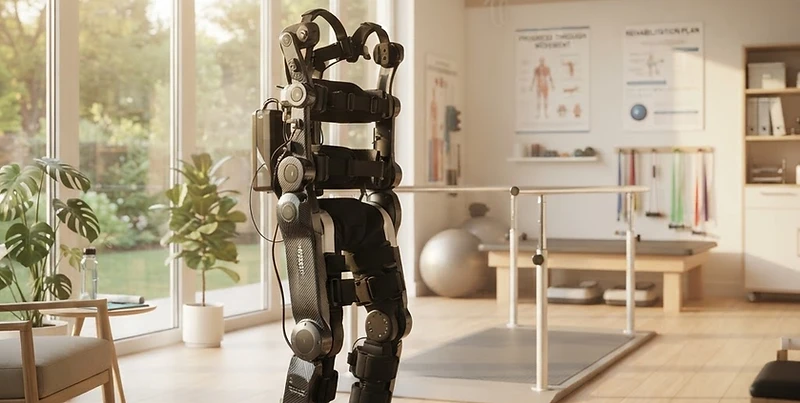
According to an account published by Wandercraft, the exoskeleton manufacturer, Montoya didn't simply use a self-balancing exoskeleton as a novelty or a one-time demonstration. He pursued it as research — pairing time in the Atalante X exoskeleton with neuromodulation therapy, in a program studying whether the combination could do more than let him stand: whether it could help rebuild the communication between his brain and the nerve networks below his injury.
The results, presented at the Society for Neuroscience's annual meeting, went beyond mechanics. Montoya saw real gains in stepping consistency and muscle activation — the kind of progress that shows up in daily function, not just in a lab session. He also reported improvements in endurance, cardiovascular conditioning, posture, and bladder and bowel function, all areas that a spinal cord injury can quietly steal along with the ability to walk.
'This has been a true team effort,' Montoya said, describing a training approach where robotic assistance is gradually reduced as the wearer takes on more of the work themselves. The shift, as Wandercraft describes it, is from being moved by the machine to actively engaging with it — and that shift is where the adaptation begins.
What makes Montoya's story matter beyond his own recovery is what it suggests about exoskeleton technology's ceiling. This isn't only a mobility aid. Used deliberately, over time, it appears able to help the body relearn function that had been written off as permanently lost twelve years earlier.
That's the same category of technology — a self-balancing Wandercraft exoskeleton — that Walk For A Hero exists to fund for veterans like Joshua Holm. Montoya's twelve years is a reminder that 'waiting' isn't the same as 'too late.'
Source: Wandercraft, "Air Force Veteran Uses Advanced Exoskeleton Training to Reclaim Upright Movement – 12 Years After Paralysis."
Comments
About the Author
Reporting and editorial content from the Walk For A Hero team, working directly with founder Glenn Baker and the veterans and families involved in the mission.
The Journal
Continue Reading


22 A Day: The Truth Behind America's Most Repeated Veteran Suicide Statistic
For over a decade, '22 a day' has been the number everyone quotes. Here's where it actually came from, what the newest VA data says instead, and where to get help right now.

Ten Years Waiting, Ten Minutes Walking: One Army Veteran's Return to His Feet
An IED in Iraq. A decade in a wheelchair. And then, after two months of training, an Army veteran stood up under his own power for the first time in nearly ten years.


Why a Walk-A-Thon? The Fundraising Model Behind Walk For A Hero
This isn't a gala, and it isn't a one-click donation button. Here's why Walk For A Hero asks people to actually walk — and how that choice changes what a dollar raised actually means.