
The First Step: Why Joshua Holm Anchors This Campaign
Why Walk For A Hero put one named veteran at the front of its campaign, how walkers fund him mile by mile, and what opens once his package is paid.


Walk For A Hero did not start with a strategy. It started with a man.
Joshua L. Holm deployed to Iraq in 2003 and served through 2004. Combat-related injuries left him paralyzed and living with traumatic brain injury. For years, the technology that could stand him back up, a self-balancing Wandercraft exoskeleton, stayed out of reach.
When the Foundation built its campaign, it made a deliberate choice: put one named veteran at the front, fund him completely, and only then move to the next. Joshua is that veteran. On the Foundation's site he is listed as Hero #1, "Hero 1 of 100."
This is why the campaign is built around a single anchor hero, how that works for the people walking for him, and what happens once his exoskeleton is paid for.
Why one name instead of a general fund
The idea behind the campaign fits in a sentence. If Americans who can walk would walk a few miles and gather pledges, the money could buy an exoskeleton for a veteran who cannot. The Foundation's own shorthand for it is a walk-a-thon with a soul.
Most charity drives raise money for a cause. Walk For A Hero raises money for a person.
The difference is practical as much as emotional. A general fund can grow for years without anyone being able to say who it helped or when. A named campaign has a finish line that everyone can see: one veteran, one exoskeleton, one $150,000 package.
That package covers the exoskeleton, five years of maintenance, travel for fitting and training, and physical therapy. Every dollar designated to a hero's campaign funds that hero's package.
A single name also keeps the Foundation accountable. Walkers and backers are not asked to trust that their money will reach "veterans" in the abstract. They can follow it to Joshua, on a public page, and watch the total climb.
The scale of the need makes that focus more important, not less. Over 20,000 people have medically qualified for exoskeleton technology in the last decade. Walk For A Hero's goal is to fund approximately 100, one complete campaign at a time.
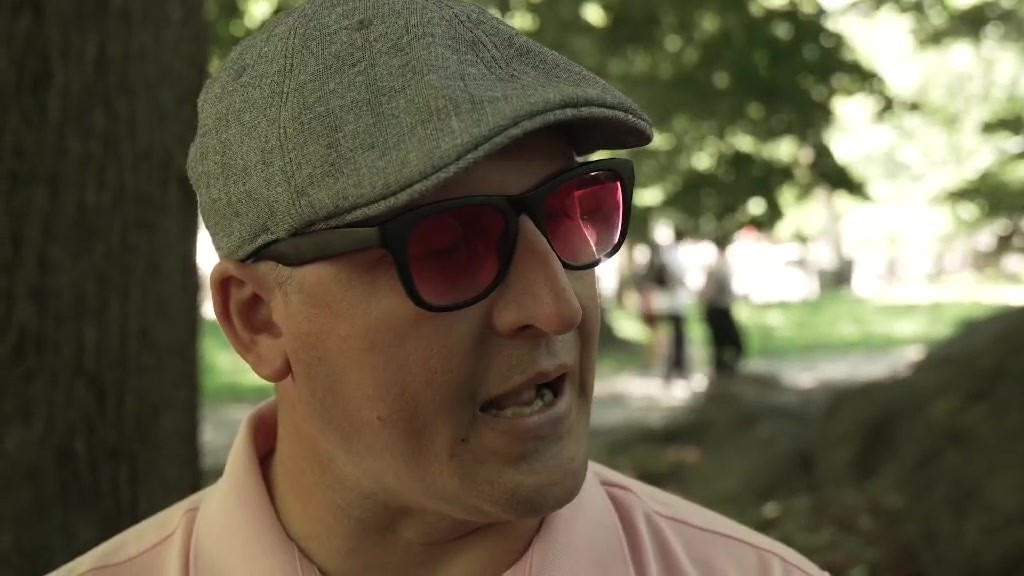
Why Joshua
Joshua is the veteran whose story set Walk For A Hero in motion. Glenn Baker, the U.S. Army Desert Storm veteran and recording artist who founded the Foundation, met him while Glenn was making his documentary, Finish This Fight: Diary of a Pissed Off American Soldier, according to the Foundation's account of its origin.
Joshua had not let his injuries end his public life. He is an author, an ordained minister and a professional speaker, and he founded Steel Hope Foundation, a nonprofit built around the creed "BE STEEL: Believe, Expand, Stand, Transform, Encourage, Enlighten, and Love." Its humanitarian work has reached as far as Nigeria.
He is a member of Paralyzed Veterans of America and gets around rough terrain in a TrackChair. What he did not have was an exoskeleton of his own. The Foundation's site sums up the answer he had been given in two words: "someday, maybe."
Joshua has since tried a Wandercraft exoskeleton during a session at Walk In New York, Wandercraft's flagship U.S. walk center. He walked in it that day. He still does not own one, and that is what his campaign is raising money to change.
The device that campaign would buy is now cleared for home use. Wandercraft received FDA clearance through the 510(k) process in August 2026 for Eve, its personal self-balancing exoskeleton, for eligible adults with spinal cord injury at any level, according to the company's announcement.
How the anchor campaign works on the site
Joshua's campaign lives on his own hero page. It carries his photo, his story, a running count of walkers and dollars raised, and the amount still needed to reach $150,000.
From that page, a visitor can do one of two things: become a walker for Joshua, or donate to Joshua directly. A link leads to the site's live progress page, where the campaign's status is shown as it updates.
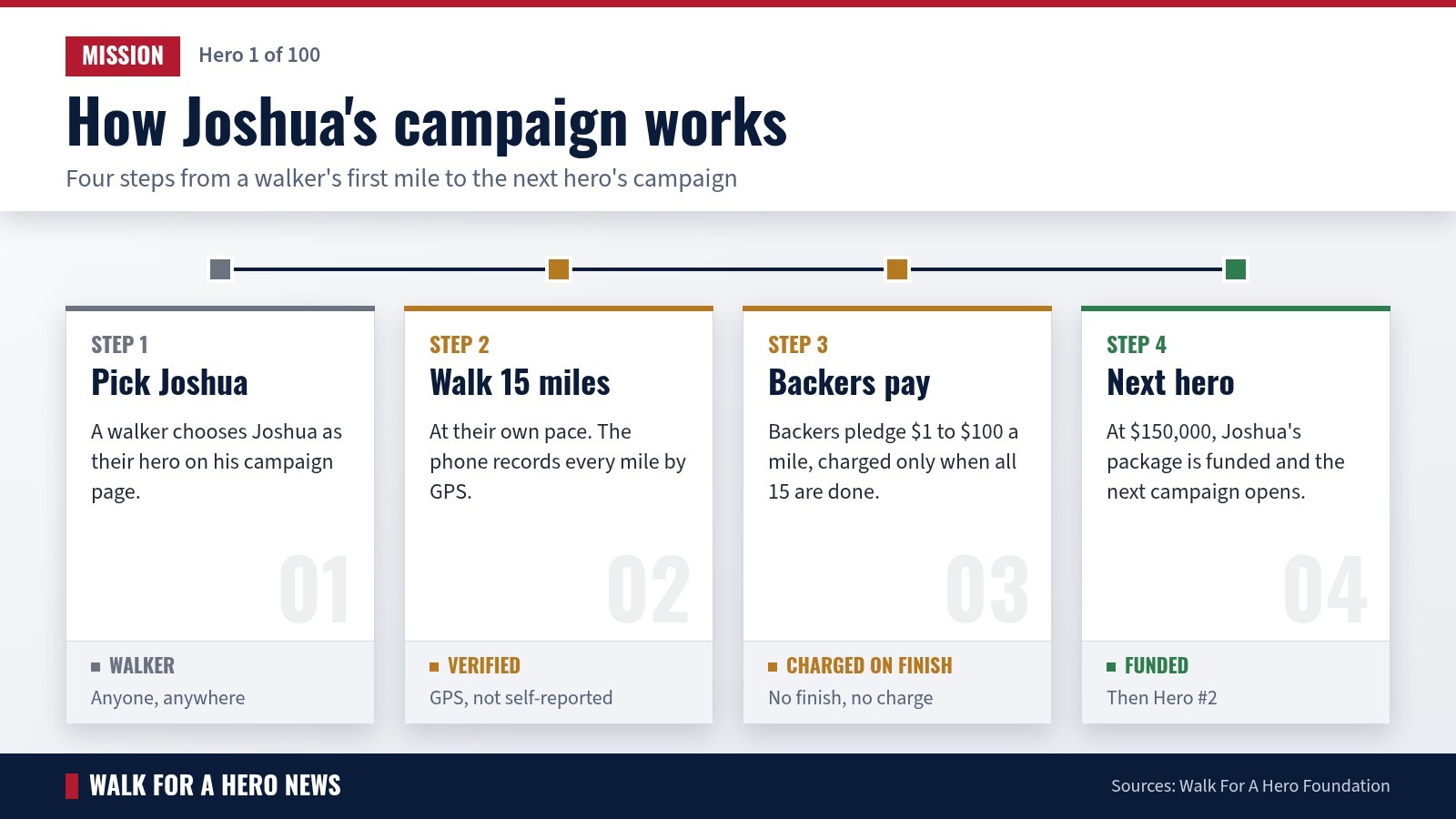
The walking is the engine. Under the Foundation's model, a walker picks a hero and commits to 15 miles, at their own pace. Their phone records the miles by GPS, so the distance is verified, not self-reported.
Each walker recruits backers from the people in their own life, who pledge $1 to $100 per mile. Cards are charged only when the walker completes the full 15 miles. If the walk is not finished, no one is charged.
The arithmetic is designed to be within reach of ordinary people. Ten backers at $5 a mile raise $750 on one walk. Two hundred walks like that fund one $150,000 package.
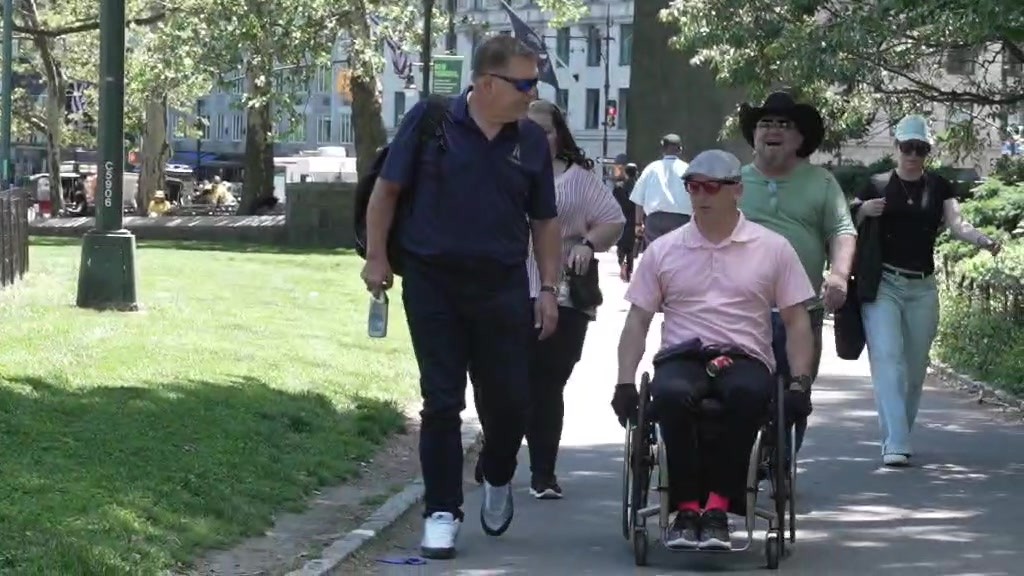
Walking for someone you have never met
The anchor-hero model asks something unusual of walkers. Most of them will never meet Joshua. They walk anyway, in their own neighborhoods, on their own schedules, toward a number on his page.
That is part of the point. Joshua's own foundation carries a line attributed to him on its homepage: "Individuals go to combat, communities go to war." Walk For A Hero applies that idea to the home front. One veteran was injured in Iraq. A community of walkers is trying to get him back on his feet.
Glenn Baker has framed the mission as a promise soldiers make to each other. "As a Warfighter, we also made an oath to our battle buddies to never leave anybody behind," he said in a statement on the Foundation's site. "We have left Warriors behind, and this mission is to fix that and get those Warriors back on their feet."
What happens next
When Joshua's $150,000 package is funded, the money goes to work. Under the Foundation's model, the exoskeleton is built, fitted and delivered, Joshua and his companion complete the required training, and the package covers five years of maintenance and physical therapy after that.
Then the next campaign opens. The next verified veteran gets a hero page, a progress bar and a $150,000 goal, and walkers can start logging miles for a new name.
People who walked for Joshua will already know the routine: pick the hero, set out on the 15 miles, line up the backers. The second campaign starts with a base of walkers the first one built.
The Foundation's target is approximately 100 heroes. Each one will be funded the same way Joshua is being funded now: in the open, one walk at a time, until the remaining balance reaches zero.
Joshua goes first because someone has to. When he stands up in an exoskeleton that belongs to him, it will show every walker, backer and veteran watching that the model works, and that the next hero is already in line.
Joshua's Journey tells his story in full, and our Wandercraft explainer covers the machine his campaign will buy.
Sources
- Walk For A Hero Foundation: About
- Walk For A Hero Foundation: Hero #1, Joshua L. Holm
- Walk For A Hero Foundation: How It Works
- Walk For A Hero Foundation: Live Campaign Progress
- Steel Hope Foundation (official website)
- Joshua L. Holm: The Man of Steel (official website)
- Wandercraft: Wandercraft Receives FDA Clearance for Eve (August 11, 2026)
Did this story matter to you?
Walk For A Hero News
Reporting from the Walk For A Hero Foundation on paralyzed veterans, exoskeleton technology, and the people walking to fund it. Have a correction or a story we should cover? Contact the newsroom.


Comments
Be the first to share your thoughts.