
22 A Day: The Truth Behind America's Most Repeated Veteran Suicide Statistic
"22 a day" is the veteran suicide number everyone quotes. Here is where it came from, what the VA's newest report says, and where to get help right now.


Twenty-two.
For more than a decade, that single number has shaped how Americans think about veteran mental health more than any study, campaign or piece of legislation. It has been printed on wristbands, painted on truck tailgates and pushed through millions of viral push-up videos: 22 veterans, the story goes, take their own lives every single day.
It is the most quoted statistic in the veteran-support world. It raised real money, built real awareness and got people talking about a crisis that used to live in silence. In the strict sense, it is also wrong, and the real story behind it is more useful than the slogan ever was.
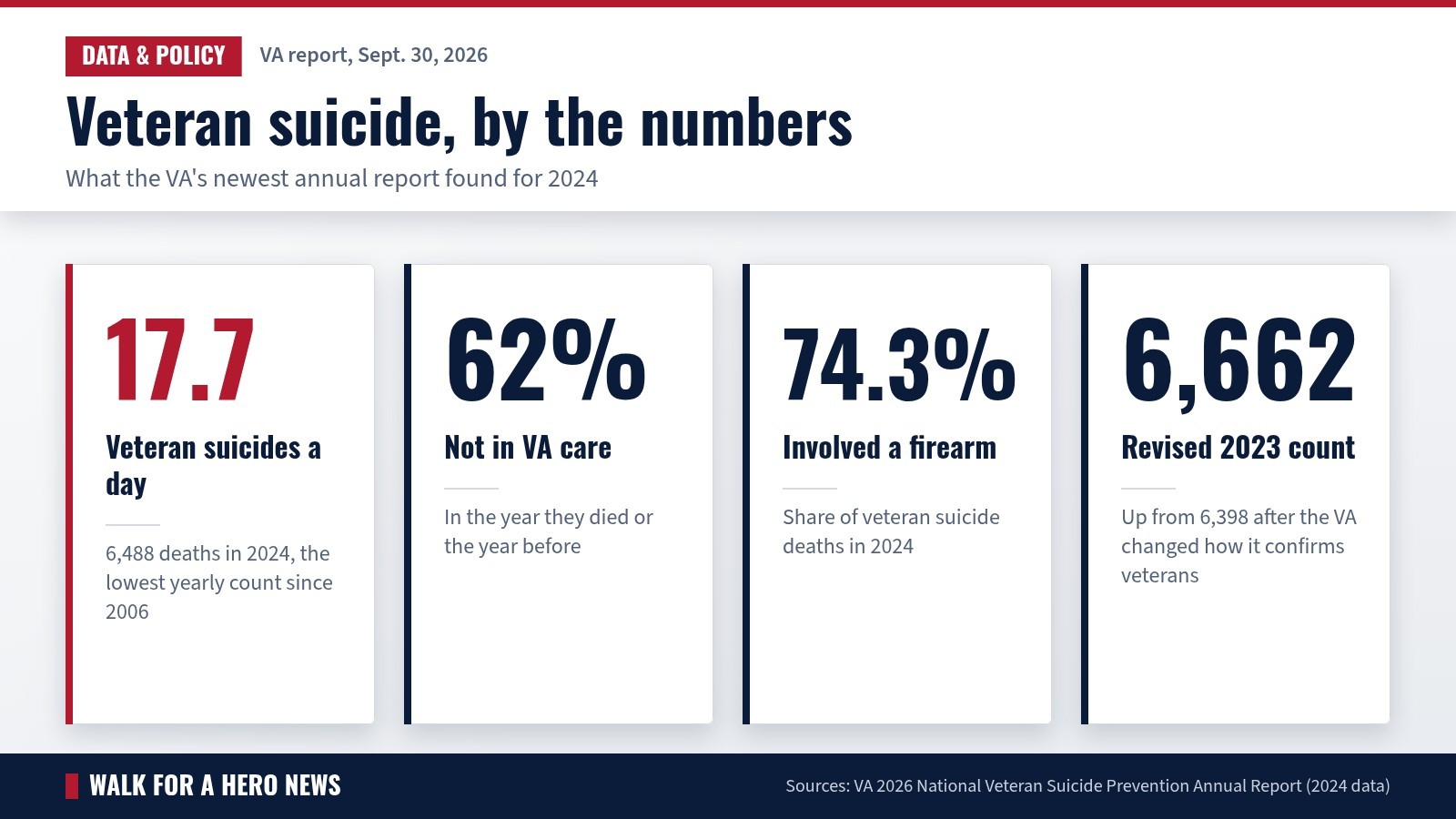
The newest federal count, released Sept. 30, 2026, puts the figure at 17.7 veteran suicides a day. Independent researchers argue the true toll is higher still. Both numbers matter, and so does the gap between them.
Where "22 A Day" Actually Came From
The number traces back to a single Department of Veterans Affairs study, the Suicide Data Report, 2012, released in 2013. Researchers pulled death-certificate data from just 21 states, not all 50. Among the suicides where military history was recorded, veterans made up about 22.2%. The VA then assumed that share held in every state and applied it to the national total.
The result, in the report's own words: "an estimated 22 Veterans will have died from suicide each day in the calendar year 2010."
The authors flagged the weaknesses in the same document. Veteran status was unknown or not reported for more than 23% of the suicides in their sample, and they recommended the estimate "be interpreted with caution due to the use of data from a sample of states and existing evidence of uncertainty in Veteran identifiers on U.S. death certificates." As PolitiFact noted in 2015, the study did not offer an actual count at all.
Caveats don't trend. Round numbers do. By the summer of 2016, "22 a day" was the engine of a viral push-up challenge, with Dwayne Johnson, Kevin Hart, Chris Pratt and John Krasinski among the celebrities posting videos.
That same summer, the VA released a far larger analysis. It examined more than 55 million veterans' records from 1979 to 2014, drawn from every state. The new estimate: an average of 20 veterans a day died by suicide in 2014. It was lower than the number everyone had memorized and still catastrophic. Like most corrections, it was largely ignored outside policy circles.
What The Data Actually Shows Right Now
The VA has refined this work every year since. The newest edition, the 2026 National Veteran Suicide Prevention Annual Report, was released Sept. 30, 2026. It covers 2024, the most recent year with national death data, and revises every year back to 2001.
In 2024, 6,488 veterans died by suicide in the United States. That works out to an average of 17.7 a day. It is 174 fewer deaths than in 2023, and the lowest annual count in the report's table since 2006.
Readers who followed last year's report will notice a change. The 2025 edition counted 6,398 veteran suicides in 2023. The 2026 edition now puts 2023 at 6,662, about 18.2 a day. The VA explains why: it updated the way it confirms veteran status, adding VA records for people who served before 2001. That change identified roughly 6,000 additional veterans among people who died of any cause from 2001 to 2023, "a portion of whom had died from suicide."
Counts also need context. The veteran population fell 31.2% from 2001 to 2024, so the report leans on rates. After adjusting for age, the 2024 suicide rate for female veterans was 99.9% higher than for women who never served. For male veterans it was 56.5% higher than for civilian men. Firearms were involved in 74.3% of veteran suicides.
Behind the 17.7 average is one veteran lost roughly every 81 minutes, every day, all year.
One number in the same report matters as much as the daily average. In the VA's words, "62% of Veterans who died by suicide in 2024 were not receiving VA healthcare in the year they died or the year prior." Most of the system built specifically to catch this crisis never got the chance. That is not a footnote. It is the whole ballgame, and it is the part most "22 a day" coverage never mentions.
VA Secretary Doug Collins framed it the same way in the department's release: "VA healthcare saves lives, so we're making every effort to get more Veterans into the system to get the care and benefits they've earned." The report backs him on the trend. From 2023 to 2024, suicide rates fell 4.8% for veterans enrolled in VA health care and rose 3.7% for those who were not.
The Number Nobody Wants To Say Out Loud
Most coverage skips a harder question entirely: whether the VA's own count, careful as it is, still understates the real toll.
America's Warrior Partnership, working with the University of Alabama and Duke University on a project called Operation Deep Dive, studied five years of death records from eight states (Alabama, Florida, Maine, Massachusetts, Michigan, Minnesota, Montana and Oregon), covering former service members aged 18 to 64. The researchers checked military service against Defense Department records and counted deaths that never get coded as suicide on a death certificate.
Their interim report, submitted to the House Veterans' Affairs Committee in 2022, estimated that if those states reflected the nation, "approximately 24 FSMs die per day by suicide." It estimated another 20 a day die from what researchers call self-injury mortality: deaths classified as accidents or undetermined that are linked to self-harm, most of them overdoses. Combined, the report said, "the combined death rate would be at least 44 FSMs per day," well over double the VA's current figure.
The group's president, Air Force veteran Jim Lorraine, did not frame it as an attack on the department. "It's not the VA's fault. The issue is the counties," he told Stars and Stripes.
This is not a case of one side lying and the other telling the truth. Death-certificate data is difficult to interpret, and reasonable researchers disagree on how to count an overdose that might or might not have been intentional. What is not in dispute: however you count it, the real number is a national emergency, and quite possibly worse than the official one.
Why This Keeps Happening
No single cause explains a crisis this large, and anyone who says it is simple is selling something. But the research points to a consistent set of pressures that stack on top of each other for too many veterans.
Leaving a highly regimented, mission-driven life for civilian anonymity means a sudden loss of structure and purpose. Pain and declining health weigh heavily: when VA suicide prevention teams reviewed the deaths of veterans in VA care from 2022 to 2024, the most common risk factors they found were pain (52.1%), sleep problems (50.5%), increased health problems (43.7%) and recent declines in physical ability (34.0%). Brain injury matters too. In 2024, the suicide rate for VA patients with a traumatic brain injury diagnosis was 111% higher than for those without one.
Then there is isolation: the loss of a unit that used to have your back, replaced by a country that, however well-meaning, mostly doesn't know how to ask.
For veterans living with major physical disability, such as paralysis or amputation, nearly every one of those pressures compounds at once. Mobility and independence disappear at the same time as the unit, the routine and often the sense of who you are outside a uniform.
The VA's National Strategy for Preventing Veteran Suicide names the factors that push the other way, including "having reasons for living or a sense of purpose in life" and "feeling connected to other people." None of that is a cure, and no serious program claims to prevent a suicide by itself. But it is the exact ground this organization was built on: give a veteran back the ability to stand, and give him or her a team that actually shows up.
What's Actually Working
The encouraging half of the new report is real, and it deserves to be told straight, without the cynicism "22 a day" has earned over the years.
VA's RISK ID screening program, launched in 2018 to flag at-risk veterans during ordinary care, completed more than 5.5 million suicide risk screenings through August 2026, according to the department. Since 2023, almost 50,000 eligible veterans have used a benefit that covers emergency suicide-prevention care at any emergency department at no cost.
The Staff Sergeant Parker Gordon Fox Suicide Prevention Grant Program, which funds community groups to reach veterans outside VA care, served about 17,000 veterans, service members and family members in 2025, a 31% increase from 2024. Its grantees have made more than 24,400 referrals for suicide prevention support, including emergency connections for more than 850 veterans at high risk. In September 2026, VA announced another $112 million in awards to 191 community organizations.
The Veterans Crisis Line answered more than 1.3 million calls, chats and texts in fiscal year 2026, up more than 7% from the same period a year earlier. The report also tracks what happens after a call. For veterans in VA care who first contacted the line in 2023, the suicide rate in the following 30 days was 15.0% lower than for those who first called in 2022. Risk after a crisis contact remains high, and the trend is moving in the right direction.
None of that erases 6,488 deaths in a single year. But it is evidence that the parts of this system built to intervene (screening, community grants and a crisis line that answers around the clock) are doing measurable work. The honest headline is not "nothing is working." It is "not enough is working yet, and here is the part that is."

Every Number In This Report Is Someone's Name
It is easy to go numb to statistics this large. Six thousand four hundred eighty-eight is not a number anyone can picture. It is 6,488 individual people who had names, units and families, and a specific morning when nobody reached them in time.
"22 a day" got that point across for a decade, even with a flawed number behind it. The real numbers (17.7 a day, 62% outside VA care, possibly 44 a day once you count what death certificates miss) don't need rounding up to make the case. They make it on their own.
This organization exists for the veterans who are still here, still fighting a quieter battle than the one they trained for. Every exoskeleton funded, every mile walked and every hero given back the ability to stand is one answer to a crisis that deserves far more people fighting it.
If you are a veteran reading this and today is a hard day, you are not required to carry it alone. The people on the other end of that call are not strangers who won't understand. They are there to understand exactly this.
Walk For A Hero News has also reported on how Army veteran Richie Neider walked again after nearly a decade in a wheelchair and on the campaign to put Iraq veteran Joshua Holm back on his feet.
Sources
- U.S. Department of Veterans Affairs, 2026 National Veteran Suicide Prevention Annual Report (September 2026)
- VA News, "VA releases annual Veteran suicide prevention report updated with 2024 data" (Sept. 30, 2026)
- VA Office of Mental Health and Suicide Prevention, Veteran Suicide Data and Reporting
- VA, 2025 National Veteran Suicide Prevention Annual Report, Part 2: Report Findings
- VA Mental Health Services Suicide Prevention Program, Suicide Data Report, 2012
- PolitiFact, fact-check of the 22-a-day figure and veteran suicide rates (Feb. 27, 2015)
- VA News, "VA releases report on nation's largest analysis of Veteran suicide" (Aug. 3, 2016)
- TheWrap, coverage of the 22 Pushup Challenge (Aug. 16, 2016)
- America's Warrior Partnership, Operation Deep Dive interim report summary, House Committee on Veterans' Affairs record (Sept. 29, 2022)
- Stars and Stripes, coverage of Operation Deep Dive findings (Sept. 17, 2022)
- VA, National Strategy for Preventing Veteran Suicide
- Veterans Crisis Line
- Veterans Crisis Line, Confidential Chat
- VA.gov, Suicide prevention (crisis contacts including TTY)
Did this story matter to you?
Walk For A Hero News
Reporting from the Walk For A Hero Foundation on paralyzed veterans, exoskeleton technology, and the people walking to fund it. Have a correction or a story we should cover? Contact the newsroom.


Comments
Be the first to share your thoughts.