
Why a Walk-A-Thon? The Fundraising Model Behind Walk For A Hero
It isn't a gala or a one-click donate button. Walk For A Hero asks people to walk 15 real miles, and the history of pledge walks explains why it works.


There is an easier way to raise money than asking people to walk real miles for it. Walk For A Hero didn't choose the easier way, and that was deliberate.
The foundation's goal is concrete: to fund approximately 100 FDA-cleared Wandercraft exoskeletons for paralyzed U.S. veterans. Each one is part of a full package that costs $150,000. And the engine it chose to raise that money is one of the oldest in American charity, rebuilt around a smartphone.
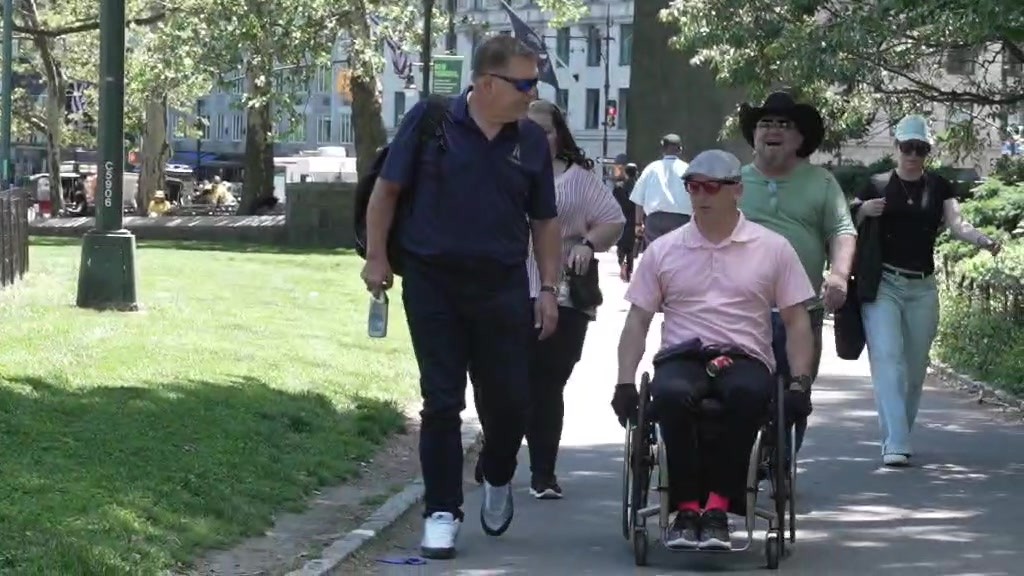
Every walker covers 15 miles at their own pace while a phone records the distance by GPS. Friends, family, coworkers and local businesses back that walk by pledging between $1 and $100 per mile. Nobody's card is charged unless the walker finishes all 15 miles.
It can look, from the outside, like a smaller idea than a gala or a telethon. The history of the walk-a-thon, a large body of fundraising data and some striking research on how donors think suggest otherwise.
An Old Idea With A Simple Rule
The pledge walk is an American institution with deep roots. In Boston, a group from a local church organized the first Walk for Hunger in 1969. Half a century later, WBUR described it as "the oldest pledge walk in the country," with one longtime volunteer having walked almost every year for five decades and raised more than $92,000 on her own.
By 1971, the idea had gone national. On May 8 of that year, Walks for Development were held in cities across the country, all sponsored by the American Freedom from Hunger Foundation. In Knoxville alone, more than 500 marchers walked 21 miles and earned $15,400, according to a University of Tennessee Libraries history. The 350 walks across the United States collectively raised $1,250,000.
The rule behind every one of those events was the same. A supporter does not simply give. A supporter promises to give when someone else does something hard. The walker carries the effort, the backer carries the money, and the miles connect the two.
That rule has outlived almost every other fundraising fad of the last half century, and for good reason.
From Church Walks To A Billion-Dollar Habit
Today the walk-a-thon sits inside a broader category the industry calls peer-to-peer fundraising: campaigns in which supporters raise money from their own networks rather than the charity asking donors directly.
The scale is enormous. The 30 largest peer-to-peer programs in the United States raised a combined $1.17 billion in 2025 from 2.63 million participants, according to the Peer-to-Peer Professional Forum's annual Top 30 survey, now in its 20th year. Revenue rose 3.4% and participation rose 3.6% from the year before.
Walks sit at the top of that list. The American Heart Association's Heart Walk was the largest program in the country at $121 million. The American Cancer Society's Making Strides Against Breast Cancer added 68,823 walkers in a single year, reaching 931,383.
"In 2025, peer-to-peer fundraising in the U.S. continued to grow at a steady and more sustainable pace," Marcie Maxwell, the Forum's chief executive, said in the survey release.
The lesson for a young foundation is straightforward. The country's biggest health charities did not abandon the pledge walk when online giving arrived. They doubled down on it, because a request from a friend reaches people that a charity's own appeal often cannot.
Why The Walking Matters
A single donation button would move money faster. Walk For A Hero insists on the walking anyway.
The reason is simple: the walk is the point, not friction in the way of the point. A veteran waiting for an exoskeleton is trying to reclaim the ability to walk. Asking able-bodied supporters to walk on that veteran's behalf, to feel in some small way the physical effort being restored to someone else, turns a transaction into solidarity. It is the difference between writing a check to a cause and standing behind it, one mile at a time.
That instinct has research behind it. In a set of five experiments published in the Journal of Behavioral Decision Making, behavioral scientists Christopher Olivola and Eldar Shafir found that "the prospect of enduring pain and exerting effort for a prosocial cause can promote contributions to the cause." They called it the martyrdom effect, and found it was strongest for causes associated with human suffering.
In one study described by Carnegie Mellon University, participants gave roughly 30% more to a shared fund when giving required them to hold their hands in ice-cold water for 60 seconds.
Not only are people willing to participate in painful, effortful events and give away their money to aid anonymous others but, the prospect of experiencing pain and exerting effort for a pro-social cause can actually lead to greater altruism.
Christopher Olivola, Carnegie Mellon University, 2014
Fifteen miles is not suffering. But it is real effort, spread over hours, and it gives a backer something specific to believe in: a person they know, doing something difficult, for a veteran who cannot yet do it himself.
Why Donors Want To See The Work
The second half of the model is visibility, and it matters as much as the walking.
American donors say trust comes first and is in short supply. In a May 2026 study, BBB's Give.org found that 67.7% of respondents consider trusting a charity essential before donating, yet only 18.3% report high trust. That gap, the group said, has been relatively stable since 2017.
What builds trust is not mysterious. In Give.org's 2024 donor survey, 75.9% of respondents said how a charity spends its money is a very important thing for watchdogs to examine, and 73.4% said the same about whether appeals are truthful, accurate and not misleading.
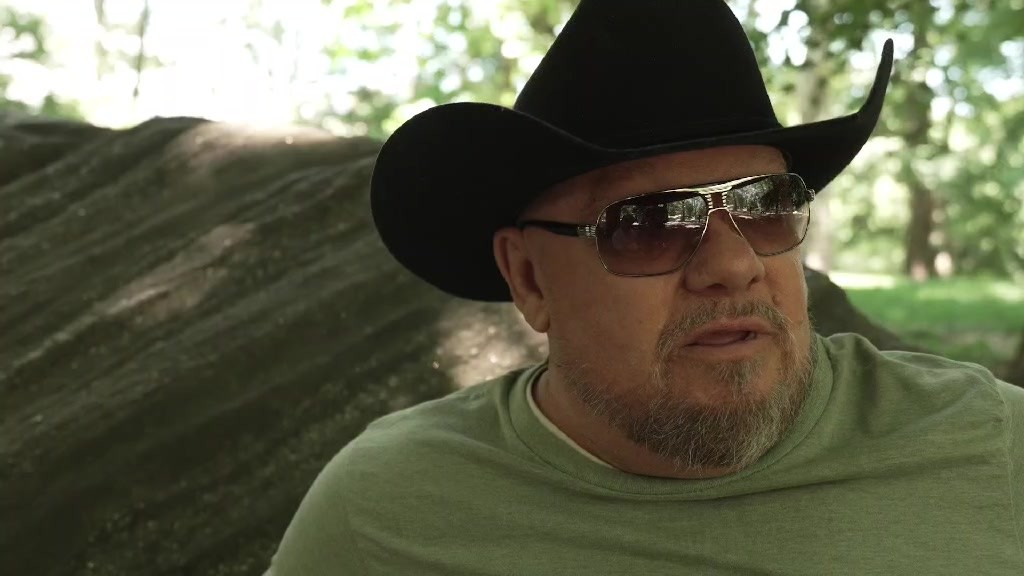
Walk For A Hero's answer is to make the work itself the proof. The walker's miles are recorded by GPS rather than self-reported. Each pledge is tied to a named walker and a named hero. And the money moves only when the miles are done.
That transparency is rare in charitable giving, and it is core to why the model works: it replaces trust-me with watch-this.
It also changes the conversation between a walker and a backer. The ask is not an open-ended request for a donation. It is a specific promise: I will walk 15 miles for this veteran, and you pay only if I finish. A backer can choose a dollar a mile or a hundred, and either way knows exactly what the money is tied to and what has to happen before a cent moves.
How The Walk For A Hero Model Works
The mechanics are designed to be simple enough to explain in a parking lot.
- The walk. A walker commits to 15 miles and covers them at their own pace. Their phone records the miles by GPS.
- The pledge. Backers pledge anywhere from $1 to $100 per mile of that walk.
- The promise. Backers' cards are charged only when the walker completes the full 15 miles.
- The destination. Every dollar designated to a hero's campaign funds that hero's package.
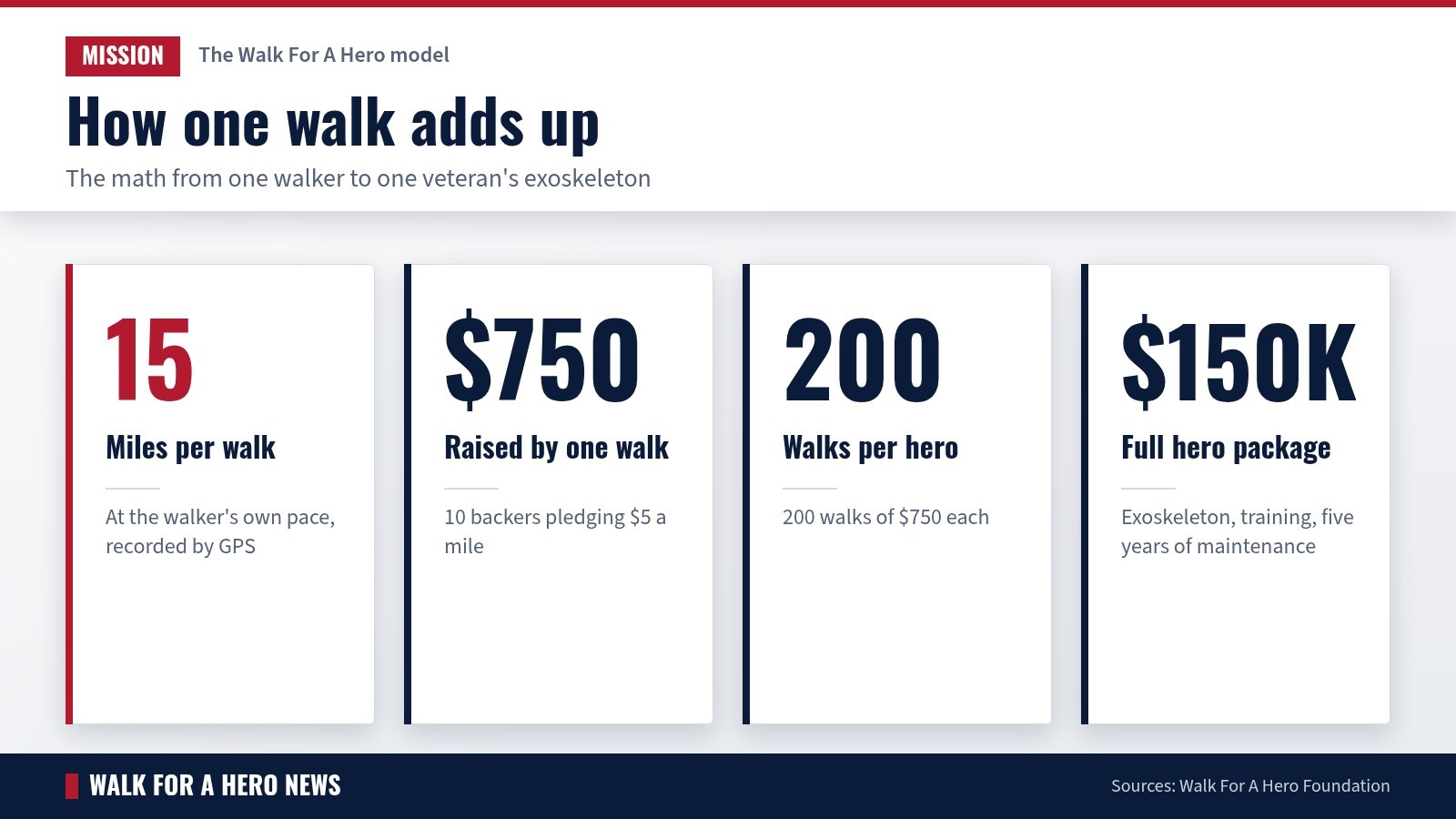
The math is built for ordinary backers. Ten backers at $5 a mile turn one 15-mile walk into $750. Two hundred walks like that fund one complete $150,000 package for one paralyzed veteran.
That package is more than a machine. It covers the exoskeleton, five years of maintenance, travel and therapy, the support that turns a device into a daily part of a veteran's life.
The technology has moved quickly. Wandercraft's Atalante exoskeleton received FDA clearance for clinical use in 2023, and in August 2026 the company secured FDA clearance for Eve, its personal exoskeleton, with a U.S. launch planned for September. The need is large. Over 20,000 people have medically qualified for exoskeleton technology in the last decade, and Walk For A Hero's goal is to fund approximately 100.
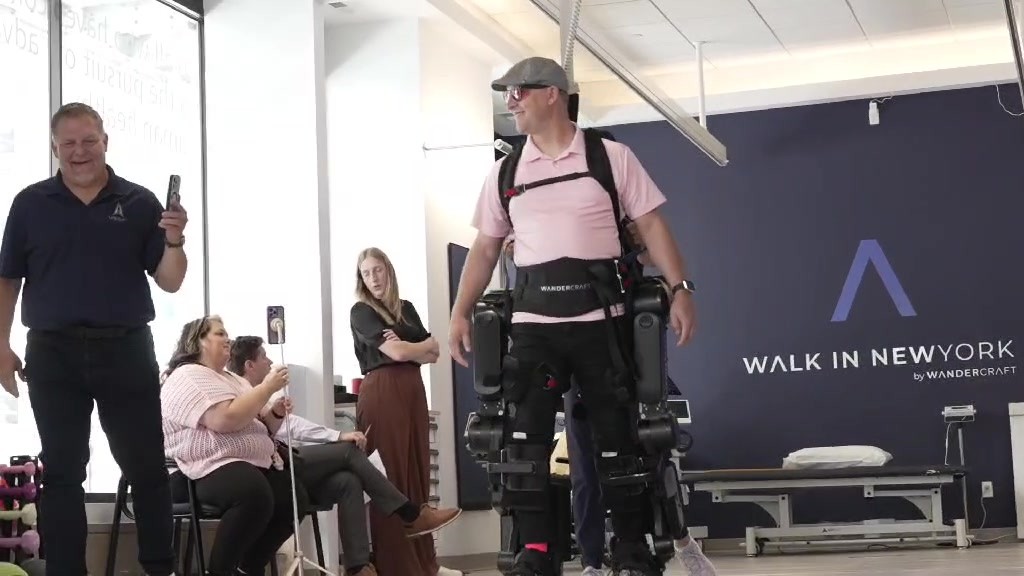
The campaign's anchor hero is Joshua L. Holm, who deployed to Iraq from 2003 to 2004. Combat-related injuries left him paralyzed and living with traumatic brain injury. He is an author, an ordained minister and a professional speaker who founded the Steel Hope Foundation. He has walked in a Wandercraft exoskeleton during a session at Walk In New York, but he does not own one. His campaign is raising the money to fund his own.
Built To Grow Town By Town
The model also scales in a way a single gala or celebrity endorsement can't.
One walker recruiting ten backers is a nice afternoon. A thousand walkers each recruiting ten backers is a funding engine. Because the walk can happen anywhere a phone can find a GPS signal, it doesn't depend on a host city, a stadium or a single date on the calendar. A walker in a small town and a walker in a big city are doing the same 15 miles for the same purpose.
That horizontal design matches the person who built it. Glenn Baker, a U.S. Army Desert Storm veteran, recording artist and documentary filmmaker, founded Walk For A Hero as a fully independent foundation around a simple idea: ordinary people walking for veterans who can't yet walk for themselves.
The pledge-on-completion rule protects backers, too. If a walk is never finished, nobody pays for miles that were never walked. When a walk is finished, the backer knows exactly what their money paid for and exactly whose package it moved forward.
A More Honest Kind Of Fundraiser
A walk-a-thon can look, from the outside, like a simpler or smaller idea than a corporate gala or a celebrity telethon. It isn't.
It is the format that has carried American community fundraising since church groups walked through Boston in 1969. It is the format the country's largest health charities still rely on to raise more than a billion dollars a year. And it is backed by research showing that effort on behalf of a cause makes giving feel more meaningful, and can make it more generous.
Most of all, it is a more honest one: every dollar traceable to a mile someone chose to walk, for a veteran waiting to walk again.
To see the model at work on one name, read why Joshua Holm anchors this campaign and what the exoskeleton in each package does.
Sources
- WBUR, Walk for Hunger coverage (May 6, 2018)
- University of Tennessee Libraries, Volopedia, "Walk for Development"
- Peer-to-Peer Professional Forum, U.S. Top 30 Peer-to-Peer Fundraising Programs (2025 results)
- NonProfit PRO, "Peer-to-Peer Fundraising Revenue and Participation Stabilize in 2025" (Feb. 25, 2026)
- Olivola and Shafir, "The martyrdom effect: When pain and effort increase prosocial contributions," Journal of Behavioral Decision Making
- Carnegie Mellon University, research release on the martyrdom effect (Sept. 16, 2014)
- BBB's Give.org, donor trust study (May 5, 2026)
- NonProfit PRO, Give.org Donor Trust Special Report coverage (Oct. 7, 2024)
- Medical Device Network, "Wandercraft self-balancing exoskeleton wins FDA clearance" (Aug. 13, 2026)
Did this story matter to you?
Walk For A Hero News
Reporting from the Walk For A Hero Foundation on paralyzed veterans, exoskeleton technology, and the people walking to fund it. Have a correction or a story we should cover? Contact the newsroom.


Comments
Be the first to share your thoughts.